
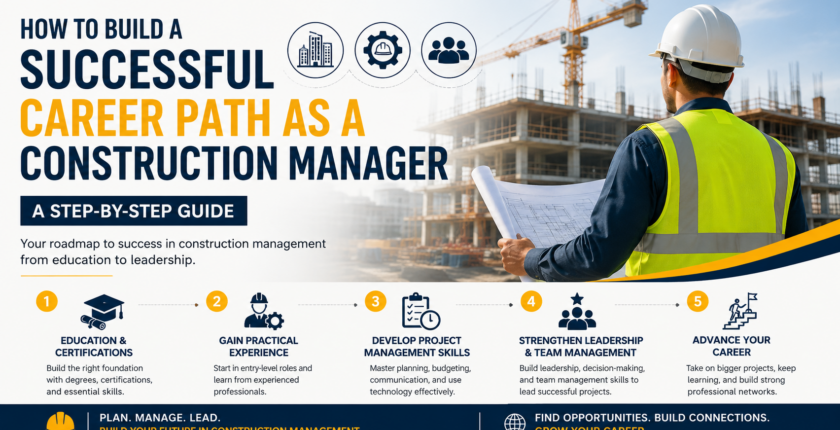
How to Build a Successful Career Path as a Construction Manager: A Step-by-Step Guide
Construction managers are vital to the success of construction projects, and they are responsible for handling both the planning and execution of the construction process and everything in between. The qualifications needed to progress in the construction profession are technical, project management and leadership-focused, and growing in complexity with the growth of construction projects. Construction management careers involve individuals managing different parts of construction projects and ensuring that everything runs smoothly and efficiently, as outlined by the U.S. Bureau of Labor Statistics.
A career trajectory assists construction management aspirants in transitioning from entry level to leadership roles. This guide covers the essential steps to build a career path as a construction manager in 2026.
Step 1: Build the Right Educational Foundation for Construction Management
Earn a Relevant Degree or Technical Qualification
A solid education will help emerging construction managers acquire important industry knowledge. The construction management or civil engineering degree allows professionals to gain a better understanding of the methods used in construction and structural concepts. It also builds safety and cost estimation knowledge. This basically allows project managers to plan the project effectively and make informed decisions on site.
Develop Industry-Relevant Certifications and Skills
Certifications are beneficial to building professionals to better their job development and field expertise. Project management tasks like project scheduling and risk management contribute to the management of project responsibilities. Coding knowledge makes things more efficient and helps to execute projects better. These abilities equip experts for higher positions in construction management.
Step 2: Gain Practical Experience Through Entry-Level Construction Roles
Start With Field-Based Construction Experience
Practical experience helps aspiring construction managers understand real project operations. Numerous employees start their careers as site engineers or field supervisors. These positions offer experience in on-the-job construction work and assist in problem solving skills. Site work is the way for professionals to get to know the workflows and requirements of the project.
Learn From Experienced Professionals
Collaborating with senior managers and project teams gives professionals a great deal of industry knowledge. They are trained in coordinating with contractors and in effective materials management. Quality control and safety compliance give valuable insight into project standards. The skills gained from watching seasoned experts also help in developing skills for future management.
Step 3: Develop Essential Project Management Skills
Master Planning, Scheduling, and Budget Management
Construction managers need to have project management skills to carry out projects successfully. Professionals should be able to develop project schedules and effectively use resources. Monitoring project progress lets you know what is happening. Excellent budget management abilities to keep costs in check and deal with unforeseen changes in the course of the project.
Improve Communication and Problem-Solving Abilities
Communication is key to a smooth working relationship between construction managers and their clients and teams. Coordinating regularly with engineering contractors and suppliers enhances project results. Good problem solving skills are used to resolve conflict and deal with challenges. Reliable project information helps make decisions and enhances project efficiency.
Use Technology to Improve Construction Management
In the digital era, construction management has become an important aspect of any construction site. Project management software is beneficial for organizing tasks and tracking the progress of a project. The knowledge of Building Information Modeling (BIM) and a data tracking system enhances project coordination. An engineering contractor’s job portal can also provide opportunities for engineers to find jobs and communicate with employers to expand their careers.
Step 4: Strengthen Leadership and Team Management Skills
Learn How to Manage Construction Teams
Construction managers need to have good leadership abilities to manage their team and guarantee that projects run smoothly. Managers need to know how to inspire their employees and project teams to work toward the goals.
Develop Decision-Making and Leadership Qualities
Construction managers are required to have good decision-making skills to manage complex construction situations. Ownership of outcomes helps to increase accountability and trust. It is important to stay confident and be able to solve problems. Good stakeholder relationships help with better partnerships and aid in the delivery of projects.
Step 5: Explore Strategies for Career Advancement in Construction Management
Take on Larger and More Complex Projects
In construction management, career development is achieved by working on bigger and more ambitious projects. Experts can advance from minimal projects to large-scale development tasks. Exposure to various facets of construction will broaden the knowledge of the construction industry and enhance the capacity to handle a wide range of project needs.
Continue Learning and Building Professional Networks
Through continuous learning, construction managers can stay abreast of industry changing practices. Participating in industry activities and learning about new construction movements can enhance knowledge of the industry. Establishing connections with established organizations and professionals opens new avenues of career development. Good networks also enable managers to learn from industry professionals and find new career opportunities.
Career Growth Roadmap for a Construction Manager
| Career Stage | Typical Role | Key Skills to Develop | Career Goal |
| Entry Level | Site Engineer / Construction Coordinator | Field knowledge, safety practices, and communication | Understand construction operations |
| Early Career | Assistant Project Manager | Scheduling, budgeting, team coordination | Manage project responsibilities |
| Mid Career | Construction Manager | Leadership, risk management, client handling | Lead complete projects |
| Senior Level | Senior Construction Manager / Project Director | Strategic planning, business management | Manage major construction programs |
Conclusion
To be successful in construction management, one must have a mix of practical experience, technical expertise, and leadership skills, along with education. Those who stay ahead of the curve and continuously seek learning opportunities will have the opportunity to grow and progress within the business world. An engineering contractor’s job portal is among the many resources that assist construction industry professionals in finding new opportunities and connecting them to companies in search of qualified and skilled professionals. Successful career planning and continuous development of competencies are essential factors for a successful career in the construction management industry.
Frequently Asked Questions
What qualifications are needed to become a construction manager?
Technical knowledge is developed through a degree in construction management or civil engineering. Career advancement is also fostered by certifications and experience.
How can a construction professional move into a management role?
Management can be attained by gaining field experience, enhancing project management skills, and building leadership capabilities.
What skills help construction managers succeed?
Planning, budgeting, communication, problem solving, team management, and construction technology are key skills.
How can construction managers advance their careers?
Construction managers can continue to improve their skill set through larger projects, certification, learning new ideas and trends, and networking.