
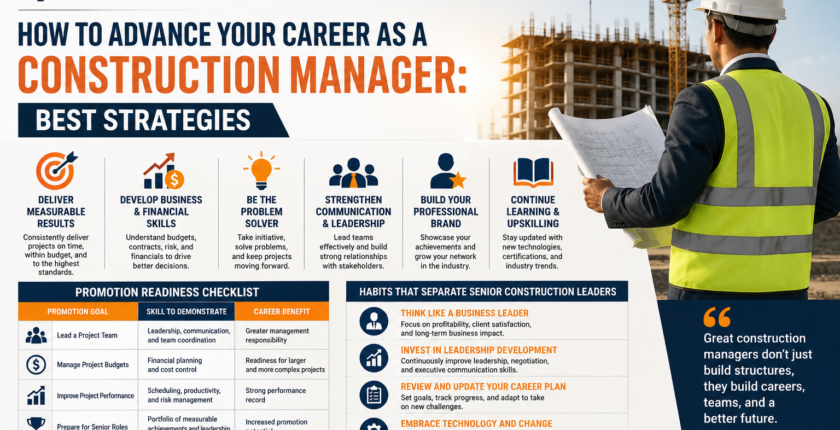
How to Advance Your Career as a Construction Manager: Best Strategies
Construction management provides individuals with chances to move up from jobs that are on-site to senior management positions where planning and decision making are required. Nonetheless, for a professional in the construction industry to be promoted, they need to exhibit leadership skills, financial knowledge, and successful projects. Professionals can stay updated on industry trends from industry insight providers such as the Associated General Contractors of America.
In this guide, you will find ways of advancing your career as a construction manager.
Understanding the Construction Management Career Ladder
A professional in construction management usually goes through various stages of leadership, such as those of Site Engineer and Assistant Project Manager before becoming a Project Manager, Senior Construction Manager, Construction Director, and an Operations Manager. While going higher up the ladder, the individual’s duties range from managing day-to-day activities on the site to budgeting, contracting, leadership, and other business goals.
Every time a person moves up, they should acquire different skills apart from the years of experience in the industry.
Strategies That Help You Advance Faster
Deliver Measurable Project Results
In order to get promoted, one must show their ability to deliver projects successfully. One should focus more on finishing projects on time and raising the level of productivity. In this case, one can point to achievements like lowering the number of delays and delivering projects successfully.
Develop Business and Financial Management Skills
In order to become a manager, one cannot just have technical skills and experience. One should learn to manage budgets and risks. Knowing financial decision making and its impact on outcomes will be useful for you in the future.
Become the Person Who Solves Problems
Construction managers should be good at solving problems that arise. One should not hesitate to take charge and solve problems on projects and cooperate with various departments.
Strengthen Communication and Team Leadership
Being able to easily communicate with a team is important to manage your employees and other stakeholders. Improve your skills in working with a team, solving conflicts and creating an efficient work environment. Good people management skills are necessary for senior construction managers.
Build Your Professional Brand
A good professional reputation can give you more career opportunities. Guarantee your resume is updated and includes information on your major projects and accomplishments. Networking and actively participating in construction communities may positively influence your reputation among potential employers.
Continue Learning and Upskilling
As the construction field constantly develops through innovations, changes in regulation, and improvements in management methods, obtaining additional certificates, gaining more technical skills, and learning new project management software can be helpful.
Promotion Readiness Checklist
Getting promoted to more senior roles in construction management will require you to show your competencies and accomplishments typical for senior managers. Check out the checklist below.
| Promotion Goal | Skill to Demonstrate | Career Benefit |
| Lead a Project Team | Leadership, communication, and team coordination | Greater management responsibility |
| Manage Project Budgets | Financial planning and cost control | Readiness for larger and more complex projects |
| Improve Project Performance | Scheduling, productivity, and risk management | Strong performance record |
| Prepare for Senior Roles | Portfolio of measurable achievements and leadership experience | Increased promotion potential |
An engineering contractors job portal can help construction management professionals connect with employers seeking candidates with project leadership skills.
Habits That Separate Senior Construction Leaders
Think Like a Business Leader
Construction leaders at higher levels consider the business implications of their work and make sure that the projects bring profits and satisfy clients. Such leaders strive for efficiency and effectiveness in resource use, which helps them develop their organizations.
Invest in Leadership Development
Effective leaders constantly enhance their competencies in managing others and leading projects. Improving one’s executive communications, negotiations and people management skills assists in becoming an effective leader and mentoring other construction leaders in the future.
Review and Update Your Career Plan
Successfully developing one’s career involves constant monitoring and upgrading. Setting annual goals, evaluating achievements and developing necessary skills ensures that professionals always stay ready for new career challenges.
Embrace Technology and Industry Changes
Senior leaders remain competitive through adaptation to new construction technologies, project management software and industry trends. Learning about such developments is essential to enhance the decision-making process.
Conclusion
Construction management career progression depends on the combination of project success, business knowledge and effective leadership skills. The ability to think strategically, solve problems, and manage a team can give a professional an advantage and open up promotion prospects.
Career development and skill improvement within the industry can open up new prospects for a professional. An engineering contractors jobs board can help an experienced construction manager find a new position.
FAQs
How should construction managers be ready to take up senior level positions?
Construction managers should be ready for senior positions by becoming competent leaders, gaining more understanding about finance and delivering successful projects on all occasions.
What qualities do employers value when promoting people into higher construction management positions?
The qualities that employers appreciate during promotion include leadership, budget management, client management, strategic planning, good communication, and decision making skills.
Why is it so important to have measurable results from projects?
Having measurable results from projects such as cost control, scheduling, safety improvements, and increased productivity will highlight a professional’s contribution and increase promotion chances.